

Enhancing burst detection for the UK’s largest water and wastewater company
Executive summary
Thames Water needed a faster way to detect and respond to bursts in its water network to reduce water loss, avoid service interruptions, and limit exposure to regulatory penalties. I worked closely with the surveillance and technical teams to design a burst notification feature within the System Risk Visualisation tool that surfaced high-signal alerts and prompted timely action. Through collaborative working sessions, rapid design iteration, and early feasibility checks with data science and engineering, we delivered a two-part notification system—combining email alerts with an in-app notification manager—that improved visibility of burst events and shortened the time between detection and response.
New bursts detected and notified
Pre-existing bursts detected and notified
Context
Client: Thames Water, Role: Product designer, Timeline: June – December 2023
Water bursts have a direct impact on customers, infrastructure, and regulatory performance. While Thames Water had systems in place to monitor network behaviour, burst detection still relied heavily on customer reports, which often came long after a burst had occurred. This delay made it difficult for operational teams to respond quickly, leading to unnecessary water loss, service interruptions, and increased risk of regulatory penalties.
Problem
Thames Water’s prompt response to bursts is critical: it reduces water loss, prevents service interruptions, and helps avoid penalties from the regulator (Ofwat). Detection relied heavily on customer calls, which often came long after a burst occurred. Evening bursts, for example, were frequently only reported the next morning — by then, large volumes of water could already be lost.
Research and Process
We ran working sessions with burst-detection specialists to map the current process and identify the minimum information needed to spot a burst quickly. I encouraged everyone to share solution ideas from their experience so we could build a shared understanding of what “good” looked like.
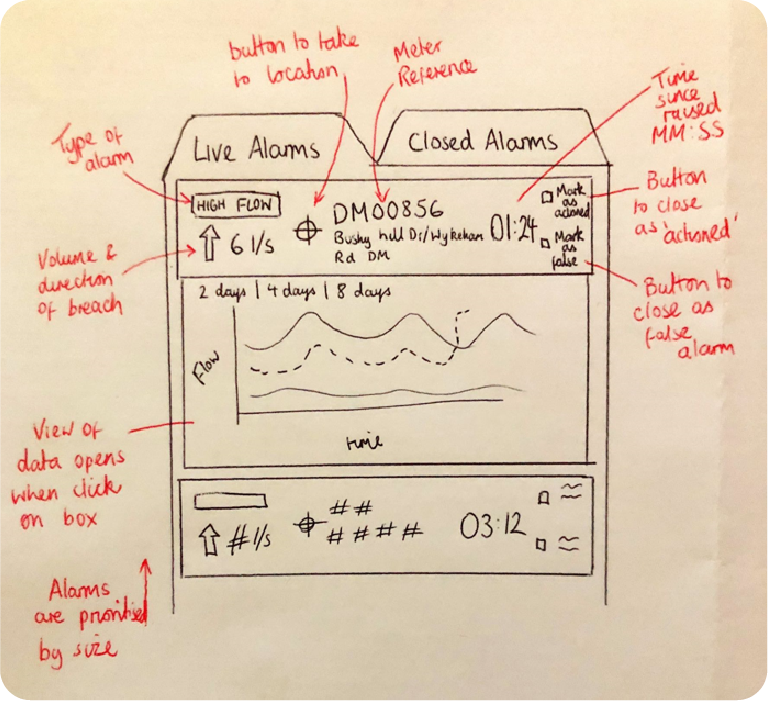
Sketch by a stakeholder during discovery.
I translated these ideas into high-fidelity Figma designs and brought them back for review, updating designs live to keep alignment tight. We also looped in software engineers and data scientists/engineers early to assess feasibility, surface constraints, and suggest alternatives. This fast review–iterate rhythm kept the team aligned and allowed us to move timeously.
Solution
We agreed on a two-part notification feature inside the company’s system-monitoring tool.
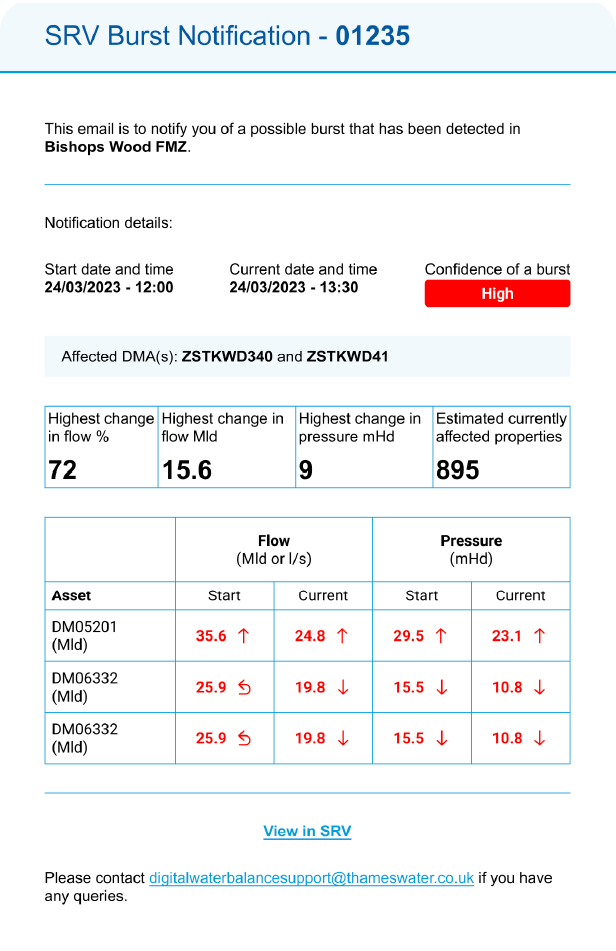
- Part 1: Email alert
- A notification email to the burst-detection team with the essentials: changes in flow and pressure on affected assets, location (FMZs and DMZs), and timestamp. The email links back to the main system for deeper investigation.
- Part 2: In-app Notification Manager
- Main window: Lists all detected burst notifications with status (new, actioned, not actioned) so users can quickly decide what to investigate.
- Notification window: Shows assets contributing to the notification, changes in pressure and flow, and lets users locate assets on a built-in map. A confidence band indicates how likely the burst is genuine. Users can mark a notification as a false positive, actioned — existing (already known), or actioned — new (previously unknown).
- Notification history: A log of prior notifications for review and correction where needed. It captures reasons for false positives, the last user to make changes, and confidence bands. This history feeds insights back to the technical team to improve the detection model and helps the burst-detection team spot areas with recurring issues that may need maintenance or replacement.
Clickable Figma prototype of the in app solution.
Impact
Since January 2024 to time of writing (January 2026), approximately 200 new bursts have been detected that the burst detection team was not aware of. Approximately 500 pre-existing bursts were detected, indicating that the tool can be relied upon in the future.
Reflections and lessons learned
- Involve subject-matter experts early and often. Their input kept the solution grounded, useful, and fit for purpose.
- Create fast feedback loops. Weekly reviews with users and the technical team helped refine both the feature and the model quickly, keeping everyone aligned and confident in what we shipped.